Paradise Fish (Macropodus opercularis)
From The Aquarium Wiki
(Redirected from Paradise fish)
Paradise Fish

Paradise Fish
Macropodus opercularis
38 Litres (10 US G.)
7-10 cm (2.8-3.9")
Freshwater
6.0 - 8.0
10 -30 °C (50-86°F)
3-15 °d
1:1-3 M:F
3-5 years
Family
Osphronemidae
This animal is available captive bred
Contents
Additional names
- Paradise Gourami, Paradise Fish, Blue Paradise Fish
Additional scientific names
- Chaetodon chinensis, Labrus opercularis, Macropodus chinensis, Macropodus ctenopsoides
Origin[edit]
- The Paradise Fish originates in Asia and is found almost anywhere with low current, such as rice paddies or calm pools on the side of flowing streams.
Sexing[edit]
- Males typically have longer fins and brighter reds than females of the same age: they also tend to be larger and more enlongated than the females. If fish are well taken care of, the females can look very similar to males and sexing these fish can be unexpectedly difficult.
Tank compatibility[edit]
- Paradise fish are surprisingly opportunistic predators and a two inch female will try to eat zebra danios of the same length head first (likely explaining cases of paradise fish ripping eyes off of other fish); thus, they should be kept with similarly sized fishes that will not intimidate the paradise fish or nip their long, trailing fins. Lone males are less likely to get along with other fish than pairs or groups, but can make excellent pet fish if kept alone in a 10 gallon. Multiple males should not be attempted in tanks less than 3 feet long.
Diet[edit]
- Paradise fish are definite carnivores in the wild, so they require a meaty diet. A high protein food must be used (eg. Tropical Flake Food, gel or pellet as opposed to most goldfish food). They will also eat small fishes, fry, and shrimp, so they could be a solution to livebearer overpopulation problems. In any case, supplementing a dry diet with live or frozen foods, such as bloodworm and daphnia, is advised for the best color and condition in the fish.
Feeding regime[edit]
- Not particularly unusual in feeding habits, the normal once or twice a day feeding regime will work for paradise fish.
Environment specifics[edit]
- Typically lives in overgrown, slow-moving waters in the wild. In the aquarium, similar conditions should be used, although it is advised to keep the current slightly higher to prevent unintended spawns from occurring. Not a true tropical fish and can take temperatures down to at least 50 fahrenheit, often lower; they make good container pond fish. Like many anabantoids, these are excellent jumpers and require a lid.
Behaviour[edit]
- Lone male paradise fish are infamously hostile in community settings, but pairs or groups are far less malicious to other species and can be kept in most communities. Spawning males become much more aggressive and will likely evict all tank mates from his half of the tank.
- Paradise fish show interesting social behaviors when kept in groups or pairs. Paradise fish may charge other paradise fish who irritate them; the target fish will lean on its side and show its stomach to the aggressor, who will either 'forgive' the target or chase it until it is sufficiently far away. If two males meet, they will flare at each other by extending their fins, darkening their colors, opening their operculum a (which have eye spots) and circling each other, occasionally jaw locking for a few seconds if this flaring match does not settle the argument. The defeated male will then flee his rival's territory, which is why a large tank is needed for multiple paradise fish males - otherwise, the defeated male may be beaten on by the victor, who thinks that the defeated male is still deliberately intruding on his territory, and may be killed.
- Paradise fish use a bubble nest to breed, like most anabantoids. After building the bubble nest, the male will flare at the female to try and entice her under the bubble nest to mate. The act of spawning itself is an 'embrace' typical of anabantoids, with the male placing the resulting eggs in the bubble nest after spawning; he will then fiercely guard the nest from all comers (including their keeper) until the fry are free swimming in about a week. The fry need infusoria at first, but can take microworms and bbs within a few days; the father should be removed after they become free swimming.
Identification[edit]
- A somewhat elongated anabantoid with a iridescent blue base color, orange or red stripes along its body, and a long, forked tail fin with those same red or orange stripes. Several captive variations exist, including an albino form. The elongated shape and distinctive tail makes it highly unlikely to be confused with the similarly-colored Colisa gouramis, and its coloring rules out confusion with any other members of its genus.
Pictures[edit]
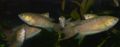
A group of Paradise Fish
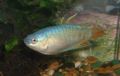
Blue Paradise Fish
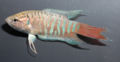
Blue Paradise Fish
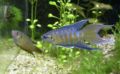
Paradise Fish Pair


External links[edit]
- Fishbase (Mirrors:
 )
)


