Discus (Symphysodon aequifasciatus)
From The Aquarium Wiki
(Redirected from Discus)
Discus

Discus
Symphysodon aequifasciatus
208 Litres (55 US G.)
15.2-20.3cm (6-8 ")
Freshwater
6.0 - 7.5
26 -30 °C (78.8-86°F)
6-13 °d
1:1 M:F
6-10 years
Family
Cichlidae
This animal is available captive bred
Contents
Additional names
- Discus, King of the Aquarium
Additional scientific names
- Symphysodon discus
Origin[edit]
- These beautiful fish come from flood plain lakes and rivers in the Amazon River basin of Brazil, Colombia, and Peru.
Sexing[edit]
- These fish are not easy to sex visually while juvenile, but it is possible with mature fish. Males have pointed dorsal and anal fin ends, while females are more rounded.
Tank compatibility[edit]
- Be cautious what fish you put with discus, as they will not tolerate most bacteria, which many fish such as Gouramis may produce. Careful selection is important, as larger fish such as the Angel, or Plecostomus may injure the discus, while smaller tankmates such as neon tetras, cardinal tetras, Cherry Barbs, etc., may be considered food. Entirely peaceful fish such as Corydoras spp. can make good tankmates with discus.
Diet[edit]
- A high protein diet is a must. Discus are cautious when accepting new foods. Mysis shrimp and krill are excellent foods. It has been suggested that bloodworms only be fed to adult discus and only sparingly. The worm's rough carapace can cause constipation if overfed, which can cause mortality especially in juveniles. Caution should be taken with frozen brine shrimp, since as they dissolve, they tend to overly cloud the tank. Cloudy water from food may lead to sickness or death of your discus.
Feeding regime[edit]
- How much Discus need to be fed is dependent on their age. Generally when aged from 0-4 months they should be fed 10 times a day. When aged 4 months - 1 year, they should be fed 5 times a day. And when aged >1 year, they can be fed twice per day.
Environment specifics[edit]
- This fish requires the highest standards of water quality, and high temperature, in the range of 32.2°C (90°F) . A large tank with still or slowly flowing water is required. Discus prefer a planted aquarium, but care must be taken to provide plants that can survive the high temperature of the water. Tanks for Discus generally need bi-weekly water changes of 20%-30% to ensure that water quality is kept pristine. The pH must be kept in check and stable. They must have a low pH and soft water with low levels (<20mg/l) of nitrate. Many keepers accomplish this through peat filtration.
Behaviour[edit]
- If left in groups, ranging from 2-4, one dominant discus may self-proclaim itself as the leader, bullying the others. Having a number greater than five will usually thin out the chain of dominance. Discus will usually leave fish too big to eat alone.
Identification[edit]
- Wild discus are normally murky brown in color, although some sort of color and/or pattern may be visible. Captive bred discus are, for the most part, exceptionally colorful, rivaling even some of the most beautiful marine fish. This is due to selective breeding. It has been said discus may be interbred several times before defects begin to show.
- There is a huge array of various colours now created through selective breeding, see them here.
Pictures[edit]
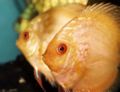
Pigeon Blood
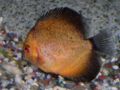
Gold Pigeon Blood
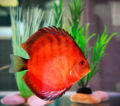
Red
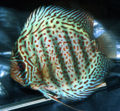
Green
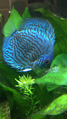
Discuss parent tending its eggs


Videos[edit]
| Discus on show at Aquarama 2007 |
Links[edit]
- Fishbase (Mirrors:
 )
)

- Wikipedia
- Tropical Fish Friends
- Discus News
- UK Discus Association
- Practical Fishkeeping Magazine
- Rocky Mountain Discus - Breeder
- USA Discus Hatchery
- USA Discus Auctions
- Discus Profile & Videos
- A Guide to Breeding and Caring for the magnificent Discus
- Discus Breeding Prep Guide
- BreedInUSA.com - USA Breeder & Seller
- Freshwater Central Discus - Freshwater Central Discus Fish


