Japanese Angelfish (Centropyge interruptus)
From The Aquarium Wiki
Japanese Angelfish

Japanese Angelfish
Centropyge interruptus
265 Litres (70 US G.)
12.7-15.2cm (5-6 ")
8.1 - 8.5
20-23.3°C (68 -74 °F)
8-12 °d
1:1 M:F
2-5 years
Family
Pomacanthidae
 |
You can contribute to the Aquarium Wiki by expanding this article. Dont be shy!. |
Contents
Additional names
- Japanese Angelfish, Japanese Pygmy Angelfish
Additional scientific names
- Angelichthys interruptus, Centropyge interruptus
Origin[edit]
- Found in the Pacific Ocean concentrated around southern and central Japan and the northwestern Hawaiian Islands (Midway and Kure).[1]
Sexing[edit]
- Females will have blue speckling across their whole body, males just on the face.
- In 1978 Moyer and Nakazono showed Centropyge interruptus to be a protogynous hermaphrodite - in other words, they enter the world without a sex. As they mature, they first take on the female sex organs. Similar to other protogynous hermaphrodites, the male is the result of a dominant female that has undergone a sex change due largely to a male that has either died or disappeared in some manner.[2]
Tank compatibility[edit]
- As with many Dwarf Angels, the Japanese Angel is best kept the only Angel to a tank unless the tank is very large (over 379 Litres (100 US G.)). They should not bother smaller more peaceful fish.
Diet[edit]
- Mainly grazes on algae, will also accept spirulina and Meaty foods.
Environment specifics[edit]
- Needs a mature tank with algae covered live rock to thrive.
Identification[edit]
- Typical oval Angelfish shape, the body is bright orange in base colour with neon blue speckles and a yellow caudal fin.
Pictures[edit]
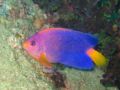
Japanese Angelfish

References[edit]
- ↑ Fishbase (Mirrors:
 )
Distribution
)
Distribution
- ↑ Reefkeeping.com What a Darling Little Angel: The Genus Centropyge

External links[edit]
- Fishbase (Mirrors: )


