Asfur Angelfish (Pomacanthus asfur)
From The Aquarium Wiki
(Redirected from Arabian Angelfish)
Asfur Angelfish

Asfur Angelfish
Pomacanthus asfur
946 Litres (250 US G.)
30.5-40.6cm (12-16 ")
8.1 - 8.4
22.2-25.6°C (72 -78 °F)
8-12 °d
1:1 M:F
5-8 years
Family
Pomacanthidae
Contents
Additional names
- Asfur Angelfish, Arabian Angelfish, Crescent Angelfish
Additional scientific names
- Chaetodon asfur, Arusetta asfur
Origin[edit]
- Western Indian Ocean: Red Sea and Gulf of Aden, south to Zanzibar.
Sexing[edit]
- The Asfur Angelfish is indistinguishable from male to female and very difficult to breed in an aquarium.
Tank compatibility[edit]
- This fish is semi-aggressive and will be territorial towards its own species. Adults need large tanks, around 681 Litres (180 US G.), in order to be kept with other tank mates. Other semi-aggressive similar-sized Angelfish are a possibility in terms of tank mates, but not the same species, and they would have to be watched carefully.
Diet[edit]
- An omnivorous fish that may nip at soft corals and clam mantles. Will accept meaty foods such as shrimp and mysis shrimp as well as spirulina and seaweed.
Feeding regime[edit]
- Feed once or twice a day.
Environment specifics[edit]
- This fish must have hiding places in order to feel secure in its environment. It needs a salinity of 1.020 - 1.025.
Behaviour[edit]
- A shy large Angelfish that will be aggressive towards others of its own kind.
Identification[edit]
- An attractive fish that is in the typical oval Angelfish shape. Adults are dark blue in colour with a yellow caudal fin and a thick crescent-shaped yellow band is down either side of the flanks. Juvenile's have blue bodies with light-blue and white stripes, as the juvenile ages it will develop yellow markings on its dorsal fin and the caudal fin will turn yellow. Can be confused with Pomacanthus maculosus and Pomacanthus koran.
Pictures[edit]
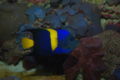
adult
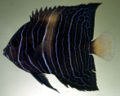
juvenile


External links[edit]
- Fishbase (Mirrors:
 )
)


