Axolotl (Ambystoma mexicanum)
From The Aquarium Wiki
 |
You can contribute to the Aquarium Wiki by expanding this article. Dont be shy!. |
Axolotl

Axolotl
Ambystoma mexicanum
76 Litres (20 US G.)
15.2-25.4cm (6-10 ")
Freshwater
6.5 - 8.0
15.6-17.8°C (60 -64 °F)
6-16 °d
1:1 M:F
5-17 years
Contents
Alternative names[edit]
- Mexican Walking Fish, Axolotl, Mudpuppy, Water Dragon
Sexing[edit]
- Mature females will have a very rounded abdomen, mature males cloaca region tends to be swollen.
Tank compatibility[edit]
- These amphibians should be kept in species tanks only, and when more than one is kept the tank should be large and well-filtered. Fish small enough will be eaten, or fish too large to be eaten are not likely at all to nibble on the Axolotl's gill feathers. Ghost shrimp can serve as harmless companions unlikely to be hunted due to the axolotl's poor eyesight, but you may lose one on occasion if they get too close during feeding or boldly bump into the axolotl's mouth. Axolotls should be kept with other axolotls of similar size to reduce the chance of bitten limbs, with great size disparity axolotls will be cannibalistic.
Diet[edit]
- Axolotls are carnivores and do best with a meaty diet. Food must be carefully considered so as to not pass on any parasites to the Axolotl. Feed them live foods such as bloodworm, earthworms, blackworm and daphnia. Earthworms are recommended to form the basis of their diet. Foods such as tubifex, feeder fish and beef heart are not recommended as they are not of much nutritional value to the Axolotl and may carry harmful parasites and bacteria. If worms are fed, they should be rinsed before feeding. Individual earthworms may be kept in a clean container with a papertowel the day before feeding so as to expel waste. Soft salmon pellets have been shown to be highly nutritional to axolotls. Sinking carnivore pellets, such as Hikari Massivore and Carnivore pellets are also suitable depending on the size of the axolotl. Axolotls will also generally not accept floating foods.
Feeding regime[edit]
- Juvenile axolotls should be feed once a day and sexually mature axolotls should be fed every second to third day. Larvae should be feed with baby brine shrimp every 2 hours. Larvae require live food until their sense of smell develops to facilitate hunting of non-moving food.
- When feeding potentially messy food such as blackworms or frozen bloodworm, it is useful to use a feeding dish; such as those used for reptiles, or a cup turned sideways. This way the considerable mess is easily removed so as not to spoil the water. A turkey baster is also useful to easily remove food waste and refuse.
- As a guide to a healthy weight, the axolotl's body should be approximately as wide as its head.
Environment Specifics[edit]
- They require coldwater temperatures, and consistent at that. The tank should be mature and fully cycled. The minimum tank size for the Axolotl is 18" long for a single adult. Escape is not generally an issue, although they are capable of jumping out of their tanks if startled or experiencing poor water quality and they cannot survive long on land. The best way to avoid escape is to have good water quality and a tank top. A wire-mesh top may be used to facilitate cooling, however an aquarium chiller may be necessary for those in substantially hot summer climates such as Australia. The water must also be very well filtered as these are messy animals, however, they must not have a tank with a strong current. Strong currents and poor water quality are the major causes of stress in axolotls which then generally leads to disease.
- Water temperatures too warm will make the axolotl susceptible to fungal growth and other problems. Very cold water can be tolerated as long as the axolotl still eats regularly. In cases of illness, it is common to keep the axolotl in the refrigerator to slow down metabolism and progression of the illness. Axolotls can also be kept in the refrigerator during short and vicious summer heatwaves as a last resort if adding ice to the tank or using a fan blowing across the top does not work to adequately cool the water in lieu of a proper chiller.
- Substrate must be carefully considered for Axolotls, they are capable of eating small gravel, pebbles, or stones which can cause impaction. Axolotls can swallow stones as large as their heads, if not a bit larger. This can easily be fatal and such unsuitable substrate should never be used with an axolotl. Axolotls have been known to live happily on a bare bottom tank which makes cleaning more efficient. However, river pebbles or sand is advised because they like to dig similarly to other salamanders. Sand must not be deeper than 1 inch otherwise anaerobic bacteria build up causing harm to the axolotl. They also must have places to hide and these can be in the form of silk plants and pvc pipes. Axolotls may uproot delicate live plants in the course of exploring the tank, but as they are carnivores, will not bother them otherwise. Axolotls eating live plants is a sign of extreme hunger. Axolotls do well with sturdy and hardy plants such as java fern.
- Axolotls should be provided with large hiding places without sharp edges. PVC pipe, terracotta pots, and suitable aquarium decor will work if of appropriate size. An axolotl should have at least two dedicated hides with more if multiples are kept.
- If lighting is used for live plants, keep in mind that axolotls dislike strong lighting. It is best to keep low-light plants with low-light bulbs and structure plants and hides so as to provide cover and an escape from the light while it is on. If live plants are not present, hood lighting is not necessary and ambient room lighting will see them more active.
- Avoid using filtration techniques which will heavily oxygenate the water as the natural environment of axolotls is at high elevations and low in oxygen. Over-aerated water will cause external gills to shrink and wither. If the aquatic environment is too low in oxygen, the axolotl will rise to the surface to take a short breath, therefore never being in great danger of suffocation. Try using canister or submersible filters to reduce surface agitation of water. Sponge filters are excellent for use with axolotls.
Behaviour[edit]
- Axolotls are curious but sometimes shy creatures. They are generally not aggressive. Any bitten limbs are caused by the axolotl thinking the limb was food. Juvenile axolotls are more active than adults, adults tend to display little activity apart from during feeding. Axolotls are nocturnal and are more likely to be active at night, sitting still and conserving energy during the day.
Breeding[edit]
- The sexually mature male initiates reproduction by nudging a sexually mature female. The male then releases small, cone shaped jelly masses that contain sperm called spermatophores. The female picks up one of the sperm parcels and fertilizes her eggs internally. Eggs are laid on any surface but plants are preferred.
- It is advisable to use fake plants instead of live plants as live plants tend to rot as the eggs develop.
- In water at 20 degrees celcius, the eggs will develop and hatch in approximately 17 days.
Identification[edit]
- Axolotls can be confused for other salamanders that are in a juvenile neotonic state, especially tiger salamanders. Axolotls have long, thin toes, while larval Tigers have fatter, more sausage-like toes.
- An Axolotl is a very unusual phenomenon in the animal world, it is a Mexican Mole Salamander that never loses it's gills and can reproduce in what is effectively still a larval stage. It's rare, but sometimes an Axolotl will metamorph into a true Salamander which behaves and looks very similar to the Tiger Salamander. Poor water conditions can induce metamorphosis as well as chemical induction and possible genetic disposition due to breeding with Tiger Salamanders. Metamorphosis results in a hugely shortened life-span and the axolotl must then be moved to a terrestrial set-up.
Pictures[edit]
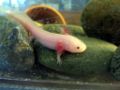
Leucistic Axolotl
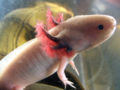
Leucistic Axolotl
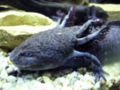
Axolotl - wild type


Videos[edit]


